Silicate
Beryl
Be₃Al₂(SiO₃)₆
SiO₂
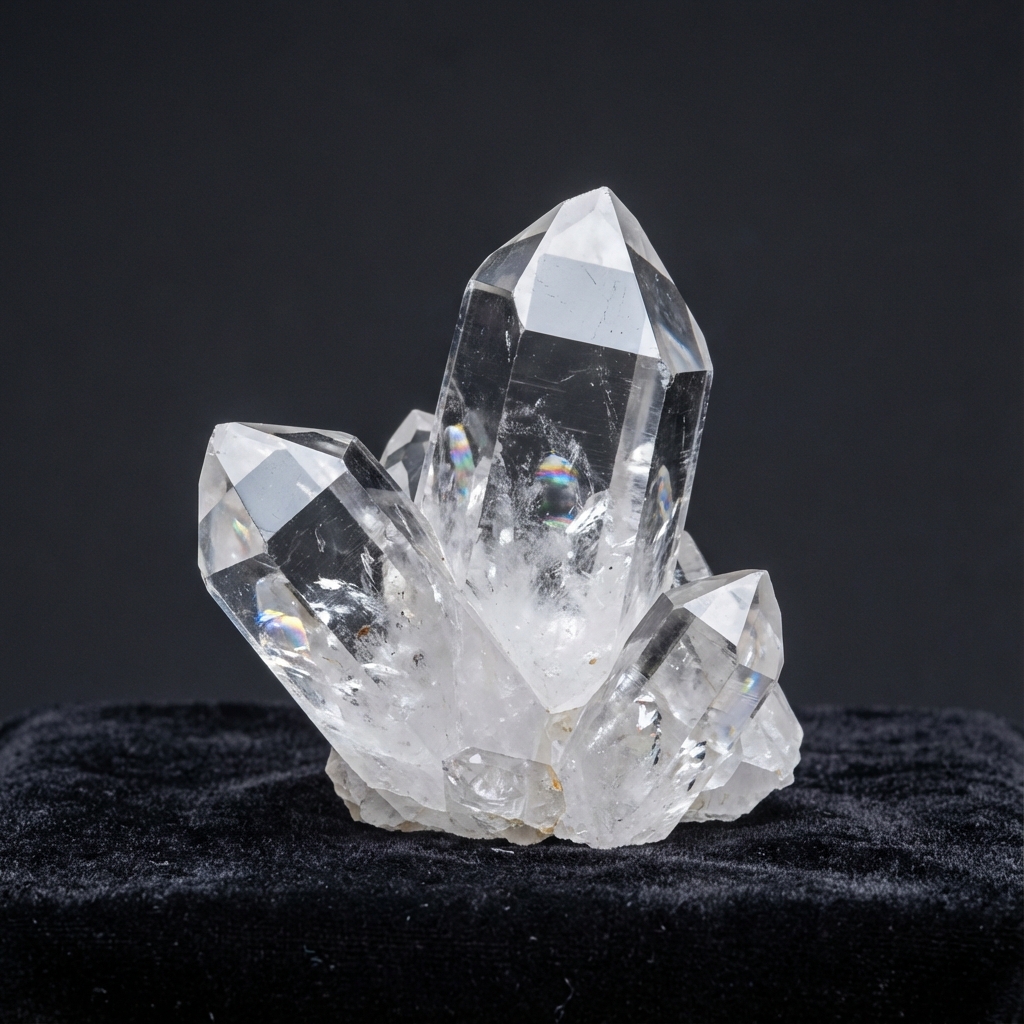
Quartz is one of the most abundant and important minerals on Earth, second only to feldspar in the continental crust and the single most common mineral in sedimentary and metamorphic sandstones and quartzites. It is composed of silicon dioxide (SiO₂) in a continuous framework of SiO₄ tetrahedra arranged in a helical structure—an arrangement responsible for quartz’s hardness, chemical stability, and piezoelectric behavior. The mineral’s extraordinary ubiquity, diversity of forms, and technological importance make it simultaneously one of the most scientifically significant and most accessible minerals in the world.
Quartz crystallizes across an unmatched range of geological environments, making it one of the most geologically versatile minerals:
Igneous rocks: Quartz is a primary crystallization product of silica-rich (felsic) magmas. Granite and granodiorite typically contain 20–40% quartz. In the final stages of magma crystallization, silica-rich residual fluids crystallize in pegmatites, producing large, well-formed quartz crystals—sometimes reaching meter scale—including the famous “Herkimer diamond” doubly terminated crystals from New York and large prismatic crystals from various pegmatite localities.
Metamorphic rocks: Quartz is a fundamental component of virtually every metamorphic rock type. Quartzite (metamorphosed sandstone) is essentially pure quartz. Quartz veins are ubiquitous in metamorphic terranes, precipitated by heated fluids during deformation and recrystallization.
Hydrothermal systems: Many economically important quartz varieties—amethyst, citrine, smoky quartz—form in hydrothermal systems where silica-saturated fluids fill cavities, fractures, and geodes. The famous amethyst geodes of southern Brazil and Uruguay formed in basaltic lava tube cavities where hydrothermal silica-rich fluids deposited amethyst crystals over millions of years.
Sedimentary environments: Because quartz is chemically resistant to weathering, it survives erosion and transport when most other minerals decompose. Quartz grains constitute the sand of beaches, deserts, and river channels worldwide. Sandstone, one of the most common sedimentary rocks, is primarily quartz grains cemented together.
Quartz belongs to the trigonal crystal system (space group P3₁21 or P3₂21 depending on handedness). The helical arrangement of SiO₄ tetrahedra creates either left-handed (L-quartz) or right-handed (D-quartz) crystals—a property called chirality. This structural chirality, combined with the absence of a center of symmetry, is responsible for quartz’s optical activity (rotation of polarized light) and piezoelectricity.
Quartz is stable at surface to moderate pressure-temperature conditions. At higher temperatures, it transforms sequentially to high-quartz (beta-quartz above 573°C), tridymite, and cristobalite—all polymorphs of SiO₂. These high-temperature forms are found as phenocrysts in volcanic rocks but are not stable at surface conditions. Coesite and stishovite are high-pressure SiO₂ polymorphs found in meteorite impact craters and deep subduction zone rocks.
Well-crystallized quartz forms the classic hexagonal prism terminated by hexagonal pyramids that virtually everyone recognizes. The prism and pyramid faces, combined with various minor forms, create the familiar quartz crystal shape. Other notable habits include:
Pure quartz is colorless (“rock crystal”), but trace elements and radiation-induced color centers produce a remarkable color range. All colored varieties are SiO₂—the same mineral with different chromophores:
Amethyst: Purple to violet color from Fe³⁺ ions in specific structural sites, activated by natural gamma radiation. The color can be bleached by heat above ~470°C. Major sources include Brazil (the world’s largest producer, particularly Rio Grande do Sul geodes), Uruguay, Zambia, and South Korea. Zambian amethyst is prized for its deep, saturated purple. Heat treatment of amethyst produces green prasiolite or yellow citrine.
Citrine: Yellow to orange-brown from Fe³⁺ in different structural sites than amethyst, or from thermally altered amethyst/smoky quartz. Most commercial citrine is heated material; natural citrine is less common and tends to be pale and smoky-yellow. Brazil is the dominant commercial source. (See also: separate citrine entry.)
Rose Quartz: Pink to rose color attributed to titanium-containing fibrous mineral inclusions (primarily dumortierite or similar fibrous minerals at nanoscale) or, in rarer crystalline form, to manganese or iron impurities. Massive rose quartz is ubiquitous; well-crystallized rose quartz is much rarer and more valuable as a specimen. Madagascar and Brazil are primary sources.
Smoky Quartz: Gray-brown to nearly black from aluminum-related color centers activated by natural radiation—the same fundamental mechanism as amethyst color. (See separate smoky quartz entry.) Scotland (Cairngorm), Brazil, and Switzerland are notable sources.
Milky Quartz: White to cloudy appearance from abundant microscopic fluid inclusions, gas inclusions, or mineral inclusions that scatter light. The most common quartz variety by volume. Used in ornamental carving; less valued than transparent varieties in the gem trade.
Prasiolite (Green Amethyst): Pale green quartz, either naturally occurring (rare) or produced by heat-treating specific amethyst material. Much prasiolite on the market is heat-treated Brazilian amethyst.
Tiger’s Eye: A pseudomorphic replacement material—fibrous crocidolite asbestos replaced by quartz while retaining the fibrous structure. The parallel fibrous structure creates chatoyancy (cat’s-eye effect) and the characteristic golden-brown color. South Africa and Australia are primary sources.
Aventurine: Quartz with abundant small platy mineral inclusions (typically fuchsite mica for green aventurine) that create a sparkling, glittery “aventurescence” effect. Green aventurine from India is the most commercially important variety.
Chalcedony and Microcrystalline Varieties: When SiO₂ crystallizes as microscopic crystals in aggregates rather than large single crystals, it forms chalcedony (fibrous microcrystalline), chert, flint, jasper (opaque, impure), agate (banded chalcedony), onyx (straight-banded agate), and carnelian (red chalcedony). These varieties are technically distinct from macrocrystalline quartz in habit but share the same fundamental chemistry.
Quartz’s piezoelectric property—the generation of electrical charge when mechanically stressed, and conversely the mechanical deformation when subjected to an electric field—was discovered by Pierre and Jacques Curie in 1880. This discovery transformed quartz from a merely common mineral into a cornerstone of modern technology.
Quartz oscillators: When a precisely cut quartz crystal (typically cut as an AT-cut or BT-cut disc or rod) is connected to an electronic circuit, it vibrates at an extremely stable, predictable resonant frequency. This frequency stability—typically better than 1 part per million per degree Celsius for AT-cut crystals—makes quartz oscillators the foundation of timekeeping in wristwatches, wall clocks, computers, smartphones, and essentially all modern electronic timing circuits. The quartz watch revolution of the 1970s made accurate timekeeping inexpensive and universal.
Frequency control in electronics: Communications systems, GPS satellites, cellular networks, and computers all rely on quartz oscillators for frequency generation and control. The global consumption of synthetic quartz for these applications is measured in hundreds of millions of units annually.
Pressure sensors: Piezoelectric quartz transducers convert mechanical pressure into electrical signals—used in medical ultrasound equipment, industrial pressure gauges, accelerometers, and seismometers.
Optical applications: High-purity fused silica (amorphous quartz) transmits ultraviolet light that ordinary glass absorbs, making it essential for UV optical systems, semiconductor photolithography lenses, and laboratory UV instruments.
The human relationship with quartz spans at least 400,000 years—the earliest stone tools made from flint and chert (microcrystalline quartz) by Homo erectus and early Homo sapiens. The ability to knap these materials into sharp-edged blades and points drove technological progress in the Paleolithic era.
The ancient Greeks called transparent quartz “krystallos,” meaning ice, believing that it was water frozen so extremely that it could never thaw. This etymology gives us the modern word “crystal.”
Clear rock crystal was among the most precious materials in medieval European and Asian cultures, valued for its clarity and the belief that it possessed magical and healing properties. Crystal balls carved from rock crystal were tools of divination and magic across cultures from Europe to East Asia.
The use of amethyst, citrine, rose quartz, and other varieties in jewelry extends back to ancient Egypt, Greece, and Rome. Amethyst was among the most prized gemstones of the ancient world, considered to prevent drunkenness (the name derives from Greek “amethystos,” not intoxicated).
Brazil: The world’s leading quartz-producing country, supplying massive quantities of amethyst (Rio Grande do Sul geodes), citrine, rose quartz, smoky quartz, and quartz crystals for both gems and industrial use.
United States (Arkansas): The Ouachita Mountains of Arkansas host extensive deposits of high-quality clear quartz crystals in a particular geological setting (Arkansas novaculite formation). Arkansas quartz is the primary source of high-purity quartz for industrial oscillator applications. Quartz mining in the Mt. Ida area is a significant regional industry.
Madagascar: Produces fine specimens of multiple varieties including colorless quartz crystals, rose quartz, and amethyst.
Switzerland and Alps: Alpine quartz localities (particularly the Haslital area in Bern) produce exceptionally clear, perfectly formed quartz crystals in smoky, morion, and rock crystal varieties—prized by collectors worldwide.
Uruguay: Famous for its deep, rich purple amethyst geodes of exceptional quality, with color saturation often exceeding Brazilian material.
In the gem trade, quartz varieties are almost universally treated with heat to improve or alter color (amethyst → citrine, smoky quartz → citrine or prasiolite). This is accepted market practice that should be disclosed. Quartz’s hardness (7) and toughness (excellent—no cleavage, conchoidal fracture) make all varieties excellent for most jewelry applications except those exposed to diamond or corundum abrasion.
Imitation quartz products abound—glass, resin, and synthetic quartz are all sold in the market. Natural quartz can be distinguished from glass by inclusions (glass is usually cleaner), thermal conductivity (quartz feels colder), and optical properties. A refractometer reading of exactly 1.544/1.553 (uniaxial) is diagnostic for natural quartz.
Clear, white, purple (amethyst), pink (rose quartz), smoky, yellow (citrine)
Not exactly. "Crystal" is a generic term often used for glass (lead crystal) or any transparent mineral. "Rock Crystal" specifically refers to clear, colorless quartz. While all quartz is crystalline, not all "crystals" are quartz.
Yes, quartz has a Mohs hardness of 7, while standard glass has a hardness of around 5.5. Therefore, a genuine piece of quartz will easily scratch a glass surface.
Quartz has a hardness of 7 on the Mohs scale.
Quartz is primarily found in Brazil - largest producer of quartz crystals, United States - Arkansas, California, Colorado, Madagascar - known for high-quality specimens.
Quartz typically occurs in clear, white, purple (amethyst), pink (rose quartz), smoky, yellow (citrine).