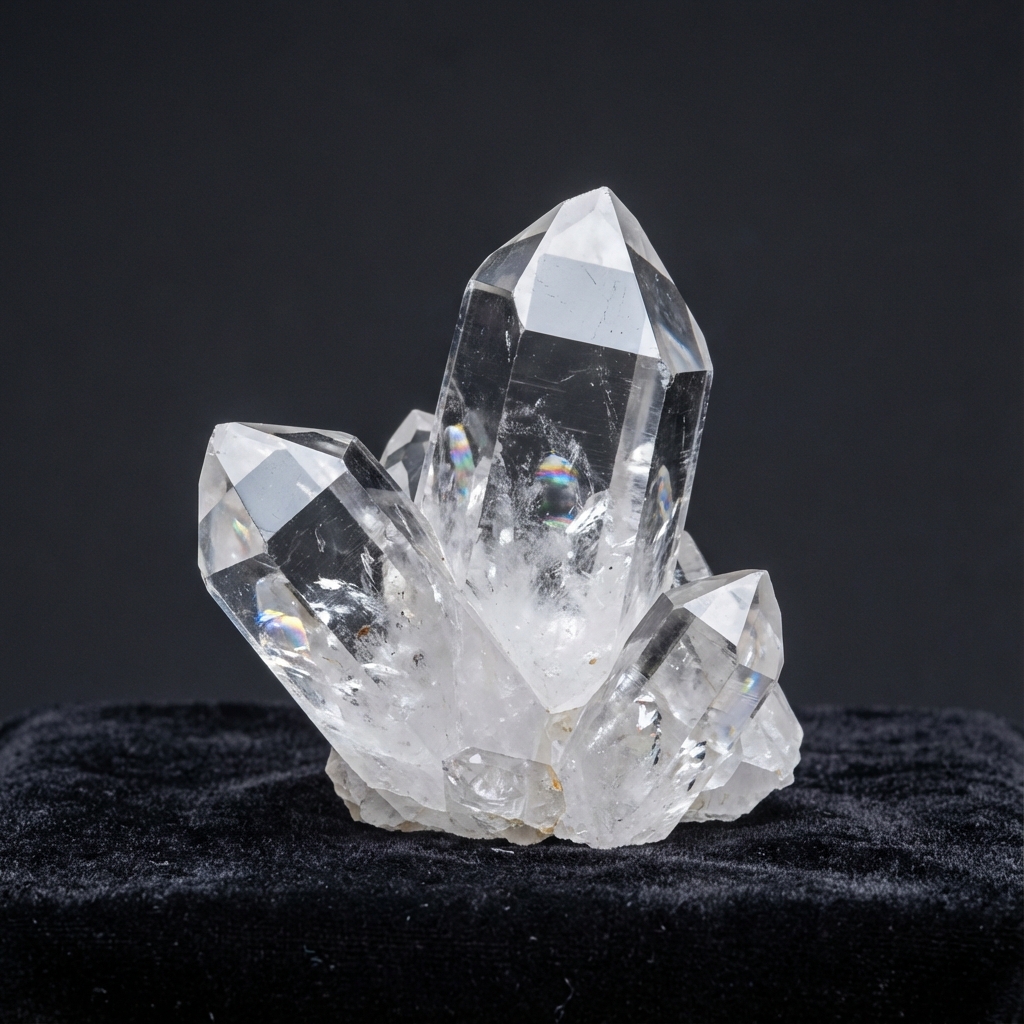
Silicate
Quartz
SiO₂
Be₃Al₂(SiO₃)₆
Beryl is one of the most mineralogically significant and commercially important mineral species on Earth—a beryllium aluminum cyclosilicate whose various color varieties include some of the world’s most beloved and valuable gemstones. Pure beryl is colorless, but trace quantities of different elements transform it into emerald (green), aquamarine (blue), morganite (pink), heliodor (yellow), goshenite (colorless), red beryl (red), and various other named varieties. The beryl family effectively encompasses a complete spectrum of fine gem colors within a single mineral species, making it unique in the gemological world.
Beryl belongs to the cyclosilicate (ring silicate) class, with the chemical formula Be₃Al₂Si₆O₁₈. The crystal structure consists of six-membered rings of silicon-oxygen tetrahedra stacked in columns parallel to the c-axis, creating channels running through the crystal. These channels are large enough to accommodate additional atoms—sodium, cesium, potassium, water molecules—which can influence color, density, and other properties.
Beryl crystallizes in the hexagonal system and characteristically forms elongated, six-sided prismatic crystals with flat, planar terminations. These are often exceptionally well-formed, making beryl specimens visually striking even before cutting. Crystal sizes range from millimeters to truly extraordinary dimensions: crystals weighing several tonnes and measuring up to 18 meters in length have been found in pegmatites in Brazil and Madagascar.
The hardness of 7.5 to 8 on the Mohs scale makes beryl quite resistant to scratching. Cleavage is poor to imperfect—beryl lacks the pronounced cleavage of minerals like fluorite or topaz—which is a significant advantage for gemstone use. The specific gravity varies somewhat by composition and variety: emerald (2.67–2.78), aquamarine (2.66–2.80), morganite (2.71–2.90), with red beryl higher at 2.84–2.92.
Beryl forms in several distinct geological environments, each associated with different varieties:
Granitic Pegmatites: The most important beryl-producing environment. Pegmatites—very coarse-grained igneous rocks crystallizing from residual volatile-rich magmatic fluids—concentrate rare elements including beryllium. The high water and fluorine content lowers viscosity and freezing point, allowing beryl and other minerals to grow as large, well-formed crystals. Most aquamarine, morganite, goshenite, heliodor, and bixbite form in pegmatites.
Metamorphic Schists and Hydrothermal Veins: Emerald’s primary geological environment is distinct from other beryls. The finest emeralds—from Colombia’s Muzo and Chivor mines—form in hydrothermal veins cutting black carbonaceous shale. In Colombia, beryllium-bearing solutions (derived from intrusive igneous rocks) mixed with chromium-bearing fluids from the shales, precipitating emerald. In other countries (Brazil, Zambia, Zimbabwe, Russia), emeralds form in metamorphic schist where beryllium and chromium are introduced by hydrothermal activity.
Alluvial Deposits: Erosion of pegmatites and metamorphic source rocks releases beryl crystals into river systems, where they concentrate in placer gravels along with other durable heavy minerals. Sri Lanka and parts of Africa yield gem beryl from alluvial deposits.
The beryl family’s diversity is unmatched among major mineral species:
Emerald: The legendary green variety, colored by chromium (Cr³⁺) and/or vanadium (V³⁺). The finest emeralds command prices exceeding diamonds of similar size—a top-quality 3-carat Colombian emerald can sell for tens of thousands of dollars per carat. Emerald is one of the four traditional precious gemstones alongside diamond, ruby, and sapphire.
Aquamarine: The blue to blue-green variety, colored by iron. Named for the Latin “sea water,” aquamarine is prized for exceptional clarity and large size. Heat treatment to remove green tones and achieve a purer blue is standard practice.
Morganite: Pink to peach to orange-pink, colored by manganese. Named after banker and gem collector J.P. Morgan, morganite has surged in popularity as a romantic, feminine alternative to pink sapphire. Major sources include Brazil (Minas Gerais), Afghanistan, and Madagascar.
Heliodor / Golden Beryl: Yellow to golden-yellow, colored by ferric iron (Fe³⁺). “Heliodor” refers specifically to the bright golden-yellow variety; “golden beryl” describes warmer yellow-to-orange material. The name heliodor means “gift of the sun” in Greek.
Goshenite: Pure, colorless beryl, free of chromophore elements. Named after Goshen, Massachusetts, where it was first described. Historically used as a diamond substitute and for making eyeglasses (the German word for spectacles, Brille, derives from Beryll).
Red Beryl (Bixbite): The rarest gem beryl—found in gem quality almost exclusively in the Wah Wah Mountains and Thomas Range of Utah, USA. Colored by manganese, it occurs in microscopic crystals that rarely exceed 2 carats in cut form. Prices rival or exceed fine emerald.
Maxixe Beryl: Deep blue beryl colored by nitrate ions rather than iron; fades dramatically in light—not a stable gem variety.
Pezzottaite: A cesium-rich variety of beryl (sometimes classified as a separate species), producing vivid raspberry-pink gems from Madagascar.
The non-gem industrial significance of beryl cannot be overstated. Beryl is the world’s primary ore of beryllium, a remarkable element with extraordinary properties: it is among the lightest structural metals (density 1.85 g/cm³, about one-third that of aluminum), has an exceptionally high stiffness-to-weight ratio, and retains strength at high temperatures.
Beryllium and its alloys are essential in aerospace (satellite structures, missile guidance systems), defense (X-ray windows, nuclear reactor components), telecommunications (precision instruments, gyroscopes), and electronics (beryllium copper alloy springs and contacts). A single space telescope mirror or satellite component may contain significant quantities of beryllium sourced ultimately from beryl ore.
The extraction of beryllium from beryl involves high-temperature smelting, fluoride extraction, and electrochemical reduction—a complex process reflecting beryllium’s tight bond in the crystal structure.
The refractive indices of beryl vary slightly by variety: emerald 1.565–1.602; aquamarine 1.564–1.596; morganite 1.572–1.600. All beryls are uniaxial negative—they have a single optic axis (the hexagonal c-axis) and are optically negative. Birefringence is generally low (0.005–0.010), meaning facet doubling is minimal.
Most beryls show pleochroism—slightly different colors or color intensities depending on the direction of viewing—with the intensity varying by variety. Emerald shows weak to strong pleochroism (yellowish green vs. bluish green). Aquamarine shows distinct dichroism (blue vs. colorless). Morganite shows weak pink vs. paler pink pleochroism.
The refractive index is moderate, giving beryl gems a pleasant vitreous brilliance without the extreme dispersion-fire of zircon or diamond. This makes beryl gems look elegant and controlled rather than flashy—a quality that has long appealed to buyers seeking refined, sophisticated jewelry.
Beryl has been used as a gemstone since antiquity. The Egyptians mined emeralds in the Sinai Peninsula and near the Red Sea as early as 1500 BCE. The Cleopatra mines near Aswan, Egypt, are among the oldest documented gem mines in the world—they were already ancient when Cleopatra is believed to have adorned herself with their emeralds.
The Romans coveted all varieties of beryl. Pliny the Elder devoted considerable discussion to beryl in his Naturalis Historia (77 CE), describing different varieties and their supposed properties. The Romans believed that emerald strengthened the eyes and was associated with Venus, goddess of love. Nero is said to have used an emerald as a monocle, though modern scholars debate this account.
The crystal balls used by medieval European seers—and the origin of the phrase “beryl balls” that evolved into “bowling balls”—were made from clear goshenite beryl rather than quartz crystal, reflecting the high value placed on large colorless beryl crystals.
When purchasing beryl gemstones, key considerations vary by variety. For emerald: color saturation and hue are paramount; clarity is secondary (inclusions are expected and accepted as the “jardin”); treatment disclosure for oil or resin filling is mandatory. For aquamarine: depth of blue color (Santa Maria quality commands premiums); clarity should be excellent; heat treatment is standard and acceptable.
For all beryl gems, certificates from recognized gemological laboratories (GIA, Gübelin, SSEF) are recommended for significant purchases, as they will identify the variety, note any treatments, and may provide geographic origin opinions for important specimens.
Most beryl varieties are reasonably durable for jewelry use. Avoid harsh chemical cleaners, ultrasonic cleaning for emeralds (which often have surface-reaching fractures filled with oil or resin that can be removed by ultrasonics), and extreme heat or sudden temperature changes. Clean with warm water, mild soap, and a soft brush. Store in separate pouches to prevent scratching by harder materials.
Green, blue, yellow, pink, red, colorless
Emerald is a specific color variety of the mineral beryl. While beryl comes in many colors (like blue aquamarine or pink morganite), only the rich green variety, colored by chromium or vanadium, is called emerald.
Yes, some varieties of beryl are considered precious stones, most notably emerald. Other varieties like aquamarine and morganite are traditionally classified as semi-precious, though they can be highly valuable.
Yes, significant beryl deposits exist in the US. Utah is famous for red beryl (bixbite), while states like Maine, New Hampshire, and South Dakota have produced large industrial beryl crystals and gem-quality specimens.
Pure beryl is colorless. Different trace elements create different gem varieties: chromium and vanadium produce green (emerald), iron produces blue (aquamarine) or yellow (heliodor), manganese creates pink (morganite) or red (bixbite).
With a hardness of 7.5 to 8, most beryl is durable enough for everyday wear. However, emeralds often contain many inclusions (called the "jardin") which can make them more brittle and prone to chipping than other beryl varieties.