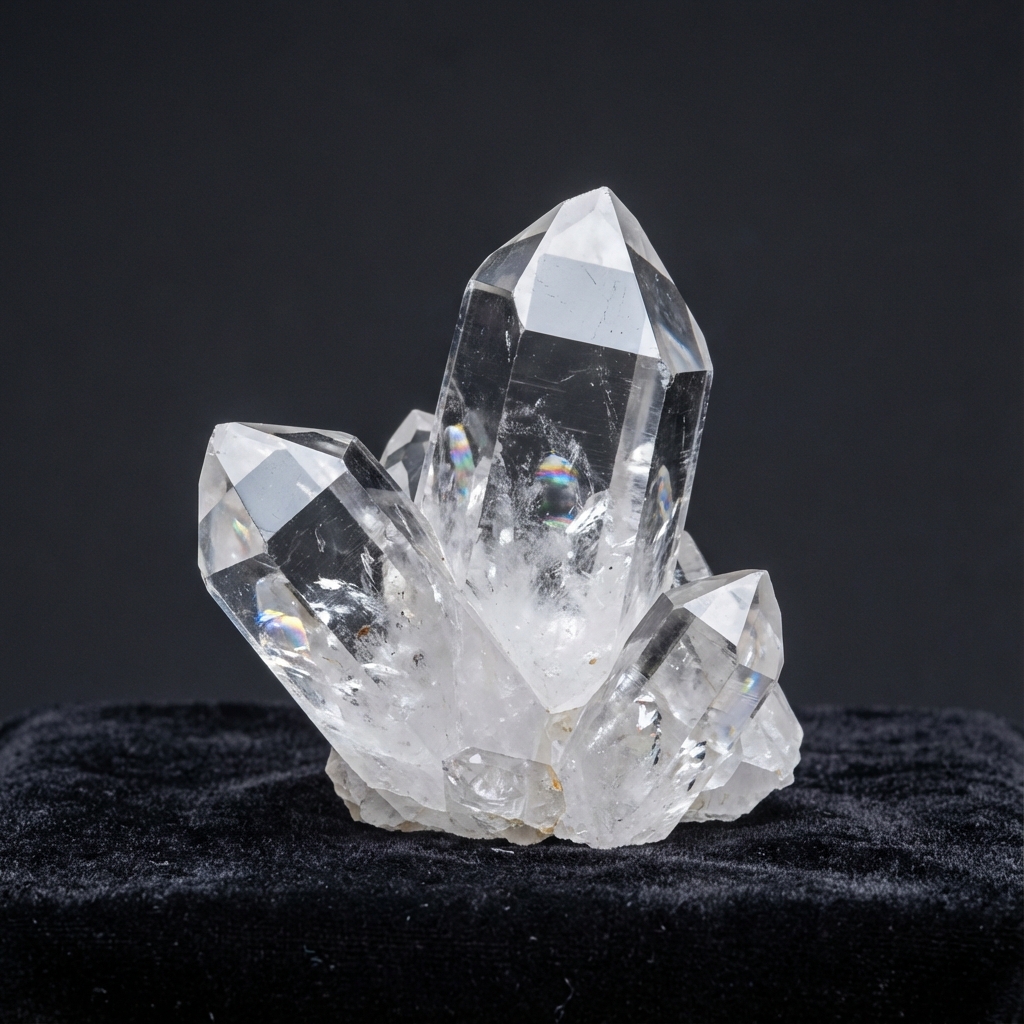
Quartz is not just another mineral—it's a cornerstone of both Earth's geology and modern technology. As one of the most abundant minerals on our planet, comprising roughly 12% of the Earth's continental crust, quartz has captivated scientists, collectors, and jewelers for centuries. Its ubiquity, combined with its diverse range of varieties, makes it the perfect starting point for any mineral enthusiast.
The Science Behind Quartz
Quartz is composed of silicon dioxide (SiO₂), one of the simplest and most stable chemical compounds found in nature. This chemical stability means that quartz is resistant to weathering; while other minerals crumble into clay or dissolve over millions of years, quartz remains. This is why the white sands of the world's beaches are primarily made of tiny quartz grains.
Its hexagonal crystal structure gives it remarkable properties that make it invaluable in various applications. The crystals often form as six-sided prisms terminating in six-sided pyramids, a shape that has become iconic in the world of crystals.
Piezoelectric Properties: The Heart of Modern Time
One of quartz's most fascinating characteristics is its piezoelectric effect, discovered by Pierre and Jacques Curie in 1880. When mechanical pressure is applied to a quartz crystal, it generates an electrical charge. Conversely, when an electrical current passes through it, the crystal vibrates at a precise, constant frequency.
This property is why quartz is essential in:
- Watches and clocks: A tiny quartz tuning fork keeps time with incredible precision, losing only a few seconds per year.
- Electronic oscillators: These control frequencies in computers, radios, and smartphones, acting as the 'heartbeat' of digital circuits.
- Sensors: Quartz is used in pressure sensors, accelerometers, and even in musical instruments like electric guitar pickups.
Varieties of Quartz: A Spectrum of Color
Quartz comes in an incredible array of colors and forms, each with its own unique beauty and geological history. These varieties are generally divided into two groups: Macrocrystalline (visible crystals) and Cryptocrystalline (microscopic crystals).
Macrocrystalline Varieties
1. Clear Quartz (Rock Crystal): The purest form of quartz, completely transparent and colorless. Ancient Greeks believed it was ice that had frozen so hard it could never melt, calling it *krystallos*. 2. Amethyst: The most prized variety, featuring purple hues ranging from pale lilac to deep violet. The color comes from irradiation of iron impurities within the crystal lattice. 3. Citrine: A yellow to golden-brown variety. Natural citrine is rare; most commercial citrine is actually heat-treated amethyst. It is known as the 'Merchant's Stone' for its association with wealth. 4. Smoky Quartz: Ranging from translucent grey to nearly black (Morion), this variety gets its color from natural radiation interacting with aluminum impurities. It is the national gemstone of Scotland. 5. Rose Quartz: Famous for its soft pink color, often caused by trace amounts of titanium, iron, or manganese. Unlike other varieties, it rarely forms distinct crystal faces and is usually found in massive chunks.
Cryptocrystalline Varieties (Chalcedony)
These form when quartz crystals are too small to be seen with the naked eye, creating a smooth, waxy texture:
- Agate: Banded chalcedony, often forming in geodes.
- Jasper: Opaque and often patterned in red, yellow, or brown.
- Carnelian: A reddish-orange variety used in signet rings for thousands of years.
Where to Find Quartz
Quartz forms in all three types of rocks: igneous, metamorphic, and sedimentary. It is a defining component of granite.
Brazil is the world's largest producer, with spectacular crystal specimens from Minas Gerais, including massive geodes of amethyst.
Arkansas, USA is famous for its high-quality clear quartz crystals, particularly from the Ouachita Mountains, which is considered one of the finest deposits of rock crystal in the world.
The Alps in Switzerland and France have historically been a source of 'Alpine Quartz,' sought after for their clarity and unique 'Gwindel' (twisted) formations.
Quartz in Daily Life and Industry
Beyond its obvious uses in jewelry and decoration, quartz plays a crucial role in modern life, often in ways we don't realize:
- Glass Manufacturing: Quartz sand (silica sand) is the primary ingredient in almost all types of glass, from windows to drinking glasses.
- Construction: As a component of concrete and mortar, quartz sand provides strength and stability.
- Hydraulic Fracturing: 'Frac sand,' consisting of durable, round quartz grains, is used in the oil and gas industry to prop open rock fissures.
- Semiconductors: Ultra-pure quartz crucibles are used to melt silicon for computer chips, as quartz can withstand the extreme heat without contaminating the silicon.
Collecting Quartz: Tips for Beginners
For mineral collectors, quartz offers endless variety. From tiny druzy crystals to massive geodes, from water-clear specimens to deeply colored varieties, there's a quartz specimen for every collection and budget.
When collecting quartz, look for:
- Luster: High-quality quartz has a vitreous (glassy) luster.
- Terminations: Crystals with undamaged points (terminations) are much more valuable than broken ones.
- Inclusions: Some quartz contains other minerals inside it, like golden rutile needles or black tourmaline rods, creating stunning visual effects.
- Localities: Serious collectors value the origin. A quartz from a famous mine in Switzerland may be worth 100 times more than a similar-looking one from a common deposit.
Conclusion
Quartz is a testament to nature's ability to create both beauty and utility. Its combination of aesthetic appeal, physical properties, and abundance makes it truly unique among minerals. It bridges the gap between the ancient world of geology and the futuristic world of electronics. Next time you encounter quartz—whether in a jewelry store, a museum, or on a hiking trail—take a moment to appreciate this remarkable mineral that has shaped both our planet and our technology.