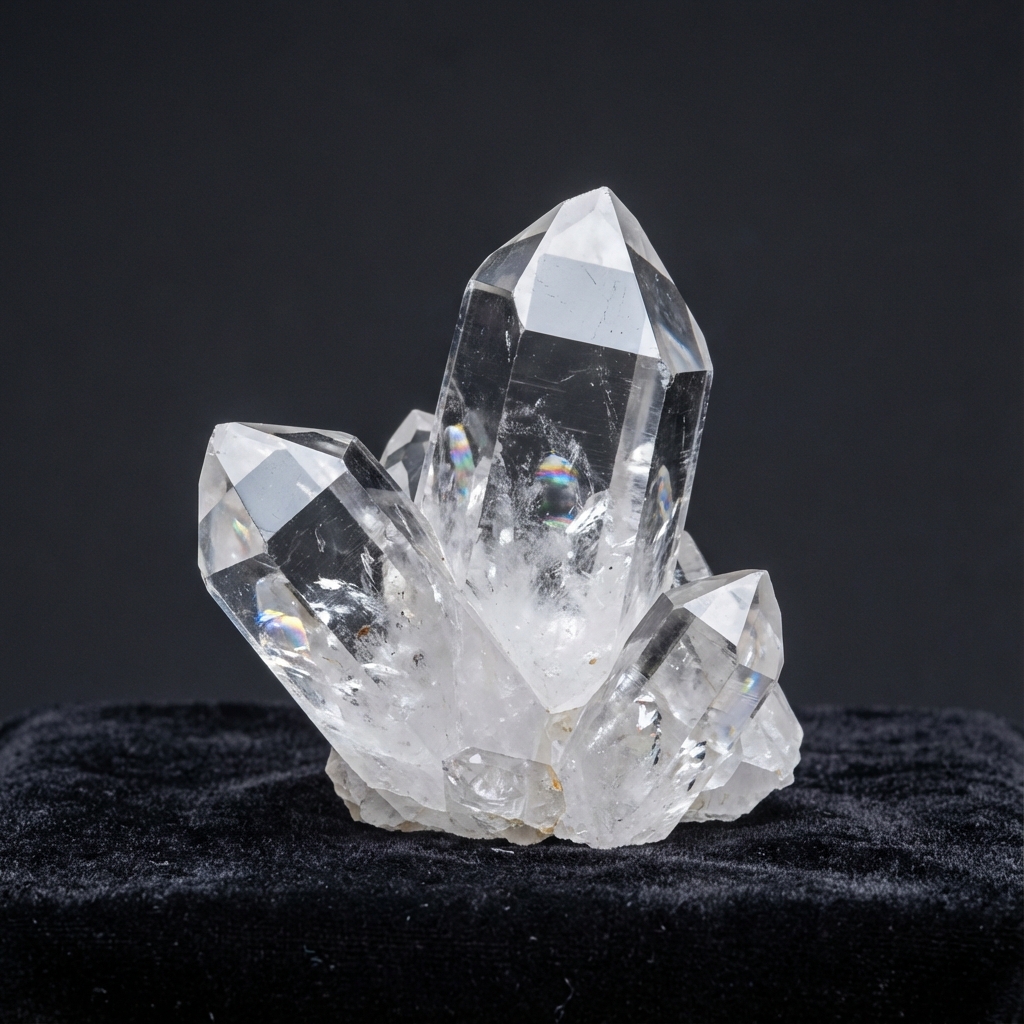
Silicate (Quartz Variety)
Prasiolite
SiO₂
Cs(Be₂Li)Al₂Si₆O₁₈
Pezzottaite is arguably one of the most breathtakingly vibrant, incredibly rare, and scientifically shocking gemstone discoveries of the 21st century. It burst onto the global gem market in late 2002, instantly captivating the jewelry world with its explosive, neon raspberry-red to purplish-pink color. Initially hailed as the greatest find of pink beryl (Morganite) in history, it soon proved to be something far more significant: an entirely new, distinct mineral species previously unknown to science.
The story of Pezzottaite began in a remote, rugged, and highly specialized granite pegmatite (the Sakavalana pegmatite) near Ambatovita in central Madagascar. Miners unearthed a single, small pocket filled with spectacular, highly transparent, deeply colored pink crystals. When these stones reached international gem labs, routine testing revealed anomalies—their density and refractive index were too high for normal beryl.
In 2003, intense X-ray analysis confirmed that the crystals were structurally different from beryl due to massive amounts of the rare element cesium. The International Mineralogical Association (IMA) officially recognized the new mineral, naming it “Pezzottaite” in honor of Dr. Federico Pezzotta, a distinguished Italian mineralogist renowned for his extensive, groundbreaking work on the complex pegmatites of Madagascar.
Pezzottaite (Cs(Be₂Li)Al₂Si₆O₁₈) is a complex cesium, beryllium, lithium, aluminum cyclosilicate. Its extreme rarity is entirely due to its required, highly specific chemical environment.
Like its close cousins in the beryl family (Emerald, Aquamarine, Goshenite), Pezzottaite forms almost exclusively in the very final, volatile-rich stages of a cooling magma body deep underground, known as a granite pegmatite. Because these late-stage fluids are incredibly concentrated with incompatible rare elements that didn’t fit into the surrounding granite, pegmatites are famous for growing massive, rare crystals.
However, for Pezzottaite to form instead of normal beryl, the pegmatite fluid must be incredibly, unusually enriched in three specific, rare elements simultaneously: beryllium, lithium, and specifically, cesium. As the magma cools, the massive cesium atoms force themselves into the open channels of the growing silicate rings. This causes the crystal lattice to distort, breaking the classic six-sided (hexagonal) symmetry of beryl and forcing the new mineral to crystallize in the trigonal system instead.
To see a high-quality, deeply colored piece of Pezzottaite is an unforgettable experience. Because it crystallizes in the trigonal system, the crystals often look superficially like flattened, deeply etched, or heavily striated hexagonal tablets or stubby prisms.
It boasts an excellent hardness of exactly 8 on the Mohs scale, making it significantly harder than quartz or garnet, and equal to topaz or beryl. It possesses very poor, indistinct basal cleavage, meaning it is an exceptionally tough gemstone, highly resistant to chipping, breaking, or splitting when struck. Because of its extreme hardness, it takes an exceptionally brilliant, vitreous (glassy) polish.
The most defining physical characteristic of gem-quality Pezzottaite is its color. The intense, vibrant, neon raspberry-red, purplish-pink, or true pink hue is caused entirely by trace amounts of manganese (Mn³⁺) combined with natural radiation in the earth. Because it is strongly pleochroic, the intense pink or purplish-red color will noticeably shift in saturation depending on the angle from which the crystal is viewed.
Because the initial, legendary pocket in Madagascar was incredibly small and quickly exhausted (yielding only a few dozen kilograms of rough material), Pezzottaite is one of the most expensive and highly prized collector’s gemstones in the world. While a few minor, secondary deposits have since been found in Afghanistan, large, transparent, flawless, deeply colored facet-grade crystals are astronomically rare.
It is far too rare for any industrial application. Its value lies entirely in high-end, bespoke jewelry and the portfolios of elite mineral investors. Heavily included or translucent rough is frequently cut into brilliant pink cabochons, which occasionally display a beautiful cat’s-eye effect (chatoyancy) due to microscopic growth tubes.
In the crystal healing community, Pezzottaite is universally considered a stone of profound, unconditional love, intense joy, and rapid spiritual acceleration. Because of its brilliant, high-frequency pink energy and its recent discovery, practitioners believe it represents the “new paradigm” of heart-centered healing. It is powerfully connected to the heart and higher heart chakras. It is widely used to provide a massive, uplifting surge of pure, compassionate energy that instantly clears the aura of heavy, karmic emotional baggage, heals deep-seated grief or feelings of unworthiness, and fosters a radiant, fearless, and deeply joyful engagement with life, encouraging the user to embrace sudden, positive transformations with open arms.
Raspberry red, vibrant pink, purplish-pink
No, but the confusion is understandable. When it was first discovered in Madagascar in 2002, everyone—including expert gemologists—assumed the brilliant, neon-pink crystals were simply a new, highly saturated variety of Morganite (pink beryl) or perhaps Red Beryl (Bixbite). However, when scientists analyzed its crystal structure, they made a shocking discovery. Pezzottaite contains so much rare cesium and lithium that its atoms arrange themselves differently from beryl. While beryl is hexagonal, Pezzottaite crystallizes in the trigonal system. In 2003, the International Mineralogical Association officially declared it a completely distinct, new mineral species.
Pezzottaite is one of the rarest gemstones ever discovered. The initial, legendary "find" in the Sakavalana pegmatite in Madagascar yielded only a few dozen kilograms of rough crystals before the single pocket was completely exhausted. While a few minor deposits have since been found in Afghanistan, the total global supply of high-quality, transparent, facet-grade Pezzottaite is astronomically small. Combined with its breathtaking, neon raspberry color and high hardness, demand from high-end collectors vastly exceeds the virtually non-existent supply.
The spectacular, vibrant raspberry-red to purplish-pink color of Pezzottaite is caused by trace impurities of manganese (Mn³⁺) substituting into the crystal lattice during formation, combined with natural, high-energy radiation in the earth.
Yes! Because it is so closely related to the beryl family, Pezzottaite possesses excellent physical properties for jewelry. It has a hardness of exactly 8 on the Mohs scale, making it significantly harder than quartz or garnet, and highly resistant to scratching from everyday wear. Furthermore, it completely lacks significant cleavage, meaning a faceted gemstone is exceptionally tough and highly resistant to chipping or breaking if bumped.
The mineral was officially named in 2003 by the scientists who first analyzed it. They chose the name "Pezzottaite" in honor of the prominent Italian mineralogist and pegmatite expert, Dr. Federico Pezzotta, who played a crucial role in investigating and documenting the incredible new pegmatite discoveries in Madagascar.